







New Exhibition Explores Pacific Northwest Forests Through a Century of Art
The Whatcom Museum is proud to announce its newest exhibition, Forested, which celebrates artists from the museum’s collection who look to the forests of the Pacific Northwest for inspiration. Part of the From the Vault series, Forested opens October 2, 2026, on Free First Friday and runs through March 7, 2027.
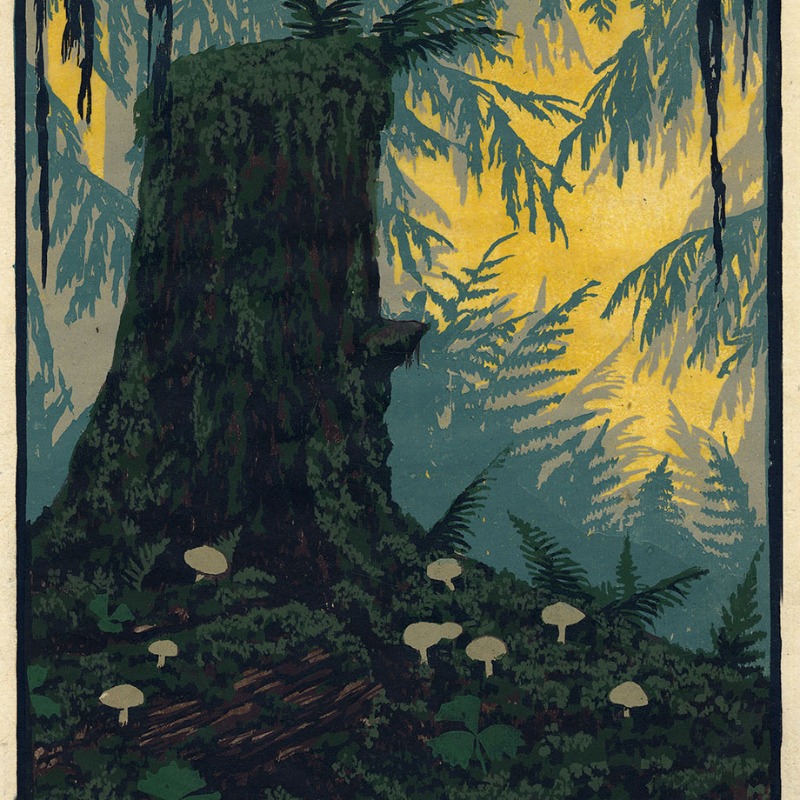
Of particular focus is a large selection of works by Bellingham artists Elizabeth Colborne and Helen Loggie.
Orphaned as a young child, Colborne moved to Bellingham in 1890 to live with her aunt. It was the forests of Whatcom County where she developed a lifelong affection for the outdoors. For most of her adult life, she divided her time between Bellingham and New York City, where she attained a national reputation as a successful illustrator, painter, and printmaker for major publications. But it was her Pacific Northwest landscapes for which she became best known.
“The Whatcom Museum is fortunate to hold the world’s largest comprehensive collection of more than 250 Elizabeth Colborne works,” said museum Chief Curator and Director of Exhibitions Amy Chaloupka, “and Forested will be the first expansive showing of her work in 15 years, with more than 60 of her woodblock prints, tempera paintings, and drawings on view.”
The last exhibition to feature works from Colborne’s sizable oeuvre was Evergreen Muse, curated by David F. Martin of the Cascadia Art Museum in 2011. That exhibition’s hard-to-find eponymous catalogue is being reprinted in a limited run in conjunction with Forested and will be available for sale at the Whatcom Museum Store beginning October 2.
“David’s vast scholarship continues to inform and expand our understanding of West Coast artists like Colborne, who was a major contributor to the regional Arts and Crafts Movement,” added Chaloupka, “and this show places her work in conversation with other collection artists for the first time.”
Image: Elizabeth Colborne, Ferns, Mushrooms and Moss, also titled In the Rain Forests of Washington, circa 1933, color woodcut, Whatcom Museum Collection, gift of the Bellingham Public Library, 1976.62.67
Artists like Helen Loggie. As a young girl, she studied with Colborne, whose art studio was just a block away from the Loggie family home in Bellingham. In 1914, Loggie moved to Massachusetts to attend Smith College and later studied at the Art Students League of New York. She intended to become a portrait painter, but it was in New York City that she discovered etching, the medium that came to typify her practice, under the mentorship of prominent etcher John Taylor Arms.
She traveled extensively to study art, but she remained deeply drawn to the forested landscapes of the Pacific Northwest. When she was 35, she returned to build a house on Orcas Island and divided her time between the island and Bellingham. It’s here that she indulged in observation. She noted individual trees’ smallest details, from leaves and needles to the contours of gnarled trunks. In a New York Times review of her first solo exhibition at Kleeman Gallery in 1938, critic Howard Devree wrote, “The artist individualizes her trees till she invests them with more personality than some portrait painters give their human beings.”
Loggie’s father and uncle owned the Whatcom Falls Mill Company, which they promoted as the “largest cedar mill in the world.” It was the success of the family business that afforded her the opportunity to go to college and travel internationally, but as an adult, she became deeply committed and outspoken to preserving the region’s natural beauty. As her sister Adele stated in the Whatcom Museum’s 1979 exhibition catalogue Beyond the Veil, “She worshiped trees, grieved over every twig. When Mt. Baker was cut, you would have thought she had lost all she loved.”
Colborne and Loggie’s works will be on view alongside those by other notable regional artists who held a deep connection with the forests of the Pacific Northwest, including Michael Brophy, Chief Bill Tsi’li’xw James (Lummi), Philip McCracken, Ernest R. Norling, Melvin Olanna (Iñupiaq), Karen Lené Rudd, an unknown Swinomish maker, James Washington Jr, and Thomas Wood.
This exhibition was generously supported by Peoples Bank and was additionally aided in scholarship by Helen Loggie Museum of Art Curator Heidi Wassan. Forested opens this Free First Friday, and guests are invited to attend an exhibition tour led by Amy Chaloupka and Wassan beginning at 1 pm in the Whatcom Museum’s Lightcatcher building (250 Flora St). The Loggie will also hold special open hours this Friday, Oct 2, from 2 – 6 pm, part of Free First Friday programming. See the full schedule online.
Catalogues for Evergreen Muse and Beyond the Veil (out of print) will be for sale at the Whatcom Museum Store beginning Oct 2, 2026, while inventory lasts.
ABOUT THE WHATCOM MUSEUM
The Whatcom Museum was founded in 1941 and overlooks Washington State’s Bellingham Bay. Notable projects have included the 2019 retrospective exhibition WANTED: Ed Bereal for Disturbing the Peace, featured in The New York Times; the award-winning, co-curated exhibition Many Wests: Artists Shape an American Idea, which traveled to the Smithsonian American Art Museum in Washington, D.C., in 2023; and Verdant: French Masterworks from the National Gallery of Art, which is on view through early 2027. The Whatcom Museum is accredited by the American Alliance of Museums.
The Whatcom Museum campus in downtown Bellingham includes three buildings: the Lightcatcher, Old City Hall, and Old Fire Station No. 1. For more information about exhibitions and admission, visit whatcommuseum.org.